Friday, March 18, 2011

Using Inferencing Skills to determine Character Traits

Grade 3

Wow! This was a tall order. Over the course of the school year we have read several chapter books. One skill we have tried to develop while reading was the use of inferencing skills to determine character traits. This activity helps the reader dig deeper into the understanding of the book through the examination of the actions, thoughts and dialogue of the characters.
With our third graders we read "Who Was Thomas Alva Edison?" It was fun learning about light through the reading of this chapter book. Students were able to develop a deeper
understanding of Edison and his accomplishments through this reading.

Who Was Thomas Alva Edison? by Margaret Frith: Item Cover


We also continued this work when we read "Revolutionary War on Wednesdays" as part of our unit on the American Revolution.


We actually began this skill in October when we read about Native Americans.


We are still working to develop this skill and are pleased with the progress. Most students are now able to recognize character traits in a story. One thing we hadn't realized when we began this venture was how limited our students' vocabulary was in this area. We were able to find a couple of wonderful character trait lists on the web and subsequently provided many lessons in this area.

Reading with a pencil


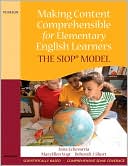
I love teaching this technique to my students. It really propels student thinking...all students. I found this version in a book entitled "Making Content Comprehensible for Elementary English Language Learners - The SIOP Model". They refer to this as the 'insert' method. We dubbed it "reading with a pencil".


Making Content Comprehensible for Elementary English Learners by Jana A. Echevarria: Item Cover

You may find other versions of the same technique, but this one seemed to be easily adapted by my second language learners. We introduced the four symbols:

v = I already knew this.
! = Wow! That was unusual.
? = I'm confused.
+ = Something new I learned.

To begin this method, we modeled the strategy focusing on ! Wow moments only. As students read, they were to "read with a pencil" and look for information they found unusual. They were to record their thinking onto sticky notes. As time progressed, we added the focus on ?: I'm confused...it is imperative that students realize when they lose meaning of what they are reading. This takes quite a bit of modeling and monitoring. Then we included +: something new I learned and finally v: I already knew this. The students can apply this to all readings. I've used this strategy with both third and fifth graders. When we ran out of sticky notes, students simply jotted down their ideas in their notebooks. It is amazing to see what they realize and learn when reading. Keeping journals helps me to continuously monitor student progress. When students are making little or slow progress, they are pulled aside for mini-lessons.

My favorite story was from a student I was sitting with when he was 'reading with a pencil'. I was sitting with a fifth grade ELL boy who was reading about the signing of the Declaration of Independence. He paused when he read that it was signed on July 4, 1776. Then he looked at me and said, "Oh, that's why we have fireworks on the Fourth of July!" I live for these moments!

Deb

Tuesday, March 8, 2011

Character Traits


While reading "My Brother Sam is Dead" our focus was on recognizing and inferring character traits. (see previous post) This book is historical fiction based on the American Revolution and takes place in Reading, Connecticut. To build background we went to a site on the smartboard to show the setting and other visuals students would need to enhance their comprehension. Here is the site we used:

http://mybrothersamisdead.historyofredding.com

Because the setting of the story actually takes place within a two hour drive of where I live, I thought I may be able to take my students there in real life. But before I did that, I thought I should check it out myself. So with my husband and kids in tow, we set out to visit the landmarks in the story. We actually found the tavern where most of the story takes place, saw Warrups Farm, landed in Putnam Field, saw an officers building and saw many road signs and school signs named after the characters in the book. We also found the grave and grave stones of many of the characters. While I was never able to actually take a group of students, because of logistics and finances, I am able to share my experience and personal photos with them.

Using the website and personal photos helps students build a deeper understanding of the story.


Sunday, March 6, 2011

Rocks and Minerals


In the past, I have found the study of rocks and minerals to be boring, but not after finding "The Story of Salt". It begins with " IT'S THE ONLY ROCK WE EAT, and we need to it it to live. It has shaped ancient civilizations, helped build empires, led to major scientific developments - and it tastes good on French fries. It's salt!" I used portions of this book to build background knowledge. I read aloud a section, then copied that section for students to reread. New sections were then copied and given to students to practice the focus strategy: summarizing. Some sections of the story are a bit 'scientific' or 'busy' but the history and uses of salt are fascinating, capturing each child's imagination. Students are very excited to go home and share with their parents about the 'rock' we humans eat!

11151197.jpg


Wednesday, March 2, 2011

List, Sort, Label


This activity really built interest when building background for our unit study on the American Revolution. We asked our third graders to look at the pictures provided, then sort them into categories. Students were to discuss how they would do this. Great conversation took place! After students categorized the pictures, they were given a sentence strip to label what the category represented. Our third graders were able to come up with 'battles', 'people', 'documents', 'maps' etc. It was a great way to spend 20 minutes activating and building their background knowledge. The next day we asked the students to look at the pictures again more closely and make some predictions. Awesome activity! Thanks to Jenn D. for this awesome idea!

Monday, February 28, 2011

Read with a Pencil!!!


It is always a challenge getting students to read and comprehend what they are reading, especially second language learners. Our students now 'read with a pencil'! While reading, students are given little sticky notes to label their thoughts. We started off by having students recognize facts that were unusual or had the "WOW" factor. While reading students would place a sticky note with an exclamation mark (!) on the page where they read something that was unusual or 'wowed' them. The next step was to add the (+) when the learned something new. We then added the (?) when students were confused or had a question about what they were reading. Finally we added the (check mark) for students to label what they already knew. At the beginning the students were 'flagging' everything in the text, so we asked them to limit their findings to only the 'most' important or unusual. We noticed that students really started paying attention to what they were reading!!!! Yahoo!

Fiction vs. Nonfiction


Students were given a variety of books that were both fiction and nonfiction. They were asked to look them over and compare and contrast them. Students excitedly poured over them. After table discussions, the class generated a list comparing fiction to nonfiction. This poster was generated and is a good tool to refer to when determining if a book is fiction or nonfiction.