Monday, October 3, 2011

"Stone Fox"


Little Willy is a wonderful character to analyze!!!

Students needed some front loading on dog sled racing and the concept of taxes, which led to a lively discussion!!!

Here is a copy of the graphic organizer we used... Sorry, I could not get it to rotate...but the website for this and other wonderful graphic organizers is

http://www.sanchezclass.com/reading-graphic-organizers.htm

"Oliver Button is a Sissy"

Oliver Button Is a Sissy

A heart-felt story about a boy who is a little different. My students were glued to this story. I used it as a read aloud to introduce narrative elements of fiction.

The students did a wonderful word sort and discussed how 'dancing' could be the problem in the story, or was it the solution?

This is a wonderful book to add to your selection no matter the grade level...all students, and teachers, can relate!!!

Wednesday, August 3, 2011

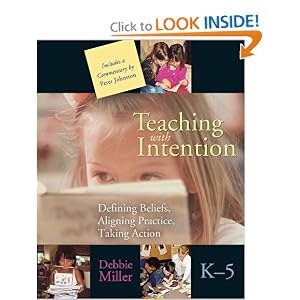
Professional Literature


"If I were to ask you to close your eyes and envision the perfect classrooms scene, what would you see? What would you hear and smell and feel? Think big! If everything were going just the way you'd like it to, what would be happening? What would your kids be doing? How about you?" Debbie Miller

I love, love, love this book! In addition to helping you define your beliefs, align your practice, and take action, Debbie also talks about 'schema theory'-connecting new learning to what we already know-in a very concrete way. She gives clear and explicit examples how to do this as well as several pages of colorful photos.

By using this book, Debbie helped me walked through my teaching practices and think deeply about them. Because of this I have a new lesson plan template I cannot wait to try out and cannot wait to get into the classroom to put in place several new ideas.

It is an interesting read with deep impact. Thank you to my colleague, Jen D., for recommending it!


Wednesday, July 6, 2011

Character Traits

While reading "My Brother Sam is Dead" with fifth grade students, they filled in the following chart to reveal character traits of the major characters. By using this form, students were asked to think deeply about the characters and discuss how their traits influenced the events in the story. One group filled in a chart on Father, another on Tim, and yet another on Sam. Some students also wanted to do a chart on Mother...a quiet, but pivotal character. At the end of the story we were able to take the charts and compare the characters. Interesting to learn how members of the same family can have similar traits, yet act and behave so differently.


Seven Simple Secrets


I just finished reading the "Seven Simple Secrets: What the BEST Teachers Know and Do!" The authors, Annette Breaux and Todd Whitaker list the seven secrets is a clear concise manner. They include detailed descriptions, examples and poems to really help the reader reflect. A great book for validation or a reminder of the impact we, as teachers, have on our students. Enjoy!


Wednesday, June 29, 2011

Teacher's Lending Literacy Library


Phew! After three weeks of collecting, sorting and cataloging, we are finally finished! Jen D., Annmarie D. and myself spent weeks gathering materials that over the years had found homes all throughout our building. Our school has tons of content materials that are literature based. However, I noticed last year when we were doing a topic of study, the books would be in one place, teacher manuals in another, videos and audios in still another! Then to make matters worse, when we were finished, I'd find more materials that could have been utilized. So, this year, our leadership gave us the 'go ahead' to weed out materials that were 10+ years old and to organize current materials according to topic of study. Although it took three weeks, it was time well spent. This coming year, teachers now have materials organized and a new lounge in which to plan curriculum.


The area is divided into various sections. First there is a case just of teacher references.These include books on differentiated instruction, small group instruction, pedagogy etc.


Next, is our first and second grade sections which boast books, adios, magazines and instant learning centers. We hope to be able to continue adding to this area for years to come.


The main portion of our materials lend themselves to third, fourth and fifth grade science and social studies. They are arranged according to topic of study for each trimester. There is also a section for ELA fiction related materials that either, directly or indirectly, support the content area. Our goal is to reinforce ELA skills through content and to piggyback subjects on one another for added exposure and support.


In addition to our content based/ELA section, we have a leveled reading section. We are very excited to be able to offer all of these materials to our teachers to invoke a stronger and more committed curriculum.


Finally our 'accountability' system...each bin has a list of materials that are housed in that particular bin located in a sleeve card. Teachers simply fill in the 'sign out' card and place it in the pocket chart hanging on the wall. When they return the bin, they simply return the 'sign out' card and store it back in the pocket with the inventory card. KISS (Keep It Simple Sweetie)

Thursday, May 5, 2011

Planting the seed in writing


Students were then asked to write an expository essay explaining how the various functions of a plant worked together to help it survive. The results were spectacular! Here is a sample of some of the third graders' work.

When students were finished, their writes were assembled into a book, and put into the reading center for all to enjoy.

Lots of Love for Teacher Appreciation Week


It is now the beginning of May...Teacher Appreciation Week. Now the front foyer to our school is adorned with hearts and flowers for the teachers. Students were able to purchase a heart or flower and send a special message to their favorite teacher for Teacher Appreciation Week. What great comments the students wrote! Now when the students enter the hallway, they are reading messages and the teachers are feeling much appreciated!!! Lots of love on the walls!


Tuesday, April 26, 2011

Rhyming Books


If you haven't heard of Dr. Suess's Learning Library Series, you are in for a treat!

"I'm the Cat in the Hat,
and I think that you need
to come take a look at
this thing called a seed."

This book discusses what grows from seeds and how
they are useful. Students enjoy the rhyming and rhythm of the story. It is so much fun to read these books-even for your reluctant readers. The series has several other content related themes. Be sure to check the out!


"Into the Book"


This website boasts a peppy tune that is difficult to get out of your head once you hear it. The lyrics help students understand the seven reading strategies. You can also print the lyrics and posters to reinforce their understanding. Above is one of the 'posters'. My students loved it!


Wednesday, April 20, 2011

Vocabulary


Multiple Meaning Words!!! My colleague, Jill the magnificent, just loves working with students on multiple meaning words. She starts the students off in a dialogue to see what they already know about the word. From there she will present sentences and ask them 'how' the word is used in the sentence using their context clues strategies. Once students are familiar with the concept, they are asked to look for multiple meaning words to add to our word wall. Students really become invested looking for these words and often use dictionaries to determine the meanings and part of speech. Later, in the vocabulary center, students are asked to use these words in sentences with their various meanings. As you can see by the word choices, we were doing a unit on plants.


LLV books by National Geographic are a wonderful resource for students to use for both content knowledge and vocabulary exploration.

vocabulary


When reading, we taught students strategies such as reading ahead, rereading, looking at illustrations, pictures, graphs, using the glossary, etc. to determine the meaning of unknown vocabulary. We start by modeling each strategy and then use the gradual release of responsibility to foster independence. Students fill in this organizer to show their thinking and to hold them accountable for their own learning. This activity is then used in our vocabulary center, which is what is pictured here.

Vocabulary


Linear Arrays! A great way to show relationships between words. I love using them. It really helps ELL's to gain a deeper meaning of new vocabulary by showing the relationship to vocabulary already known.


Interesting Leads

"Would you stand in the front line of a battle?" "What kind of a person would you do business with?" These are some of the interesting leads our third grade students came up with to 'hook' the reader! Each student choose a famous historical figure from the American Revolution and was asked to write about one of their character traits with supporting evidence from their research. Students then had to 'hook' the reader with an interesting lead. A great way to write a report through the lens of character traits.


"What would it be like to be a scientist?" Read about Benjamin Franklin and find out what it takes to be a famous inventor.


"Do you know who the first African American poet was? Well, it was Phillis Wheatley...."

Monday, April 18, 2011

Mini Lessons


I loved this shutterfly post on anchor charts! Not only does it give you some great tips, but as you view them you can see how some of the charts evolved over time. Thanks again to Christine K. for a wonderful recommendation. :)


Click here to view these pictures larger

Friday, March 18, 2011

Using Inferencing Skills to determine Character Traits

Grade 3

Wow! This was a tall order. Over the course of the school year we have read several chapter books. One skill we have tried to develop while reading was the use of inferencing skills to determine character traits. This activity helps the reader dig deeper into the understanding of the book through the examination of the actions, thoughts and dialogue of the characters.
With our third graders we read "Who Was Thomas Alva Edison?" It was fun learning about light through the reading of this chapter book. Students were able to develop a deeper
understanding of Edison and his accomplishments through this reading.

Who Was Thomas Alva Edison? by Margaret Frith: Item Cover


We also continued this work when we read "Revolutionary War on Wednesdays" as part of our unit on the American Revolution.


We actually began this skill in October when we read about Native Americans.


We are still working to develop this skill and are pleased with the progress. Most students are now able to recognize character traits in a story. One thing we hadn't realized when we began this venture was how limited our students' vocabulary was in this area. We were able to find a couple of wonderful character trait lists on the web and subsequently provided many lessons in this area.


Reading with a pencil


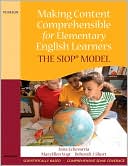
I love teaching this technique to my students. It really propels student thinking...all students. I found this version in a book entitled "Making Content Comprehensible for Elementary English Language Learners - The SIOP Model". They refer to this as the 'insert' method. We dubbed it "reading with a pencil".


Making Content Comprehensible for Elementary English Learners by Jana A. Echevarria: Item Cover

You may find other versions of the same technique, but this one seemed to be easily adapted by my second language learners. We introduced the four symbols:

v = I already knew this.
! = Wow! That was unusual.
? = I'm confused.
+ = Something new I learned.

To begin this method, we modeled the strategy focusing on ! Wow moments only. As students read, they were to "read with a pencil" and look for information they found unusual. They were to record their thinking onto sticky notes. As time progressed, we added the focus on ?: I'm confused...it is imperative that students realize when they lose meaning of what they are reading. This takes quite a bit of modeling and monitoring. Then we included +: something new I learned and finally v: I already knew this. The students can apply this to all readings. I've used this strategy with both third and fifth graders. When we ran out of sticky notes, students simply jotted down their ideas in their notebooks. It is amazing to see what they realize and learn when reading. Keeping journals helps me to continuously monitor student progress. When students are making little or slow progress, they are pulled aside for mini-lessons.

My favorite story was from a student I was sitting with when he was 'reading with a pencil'. I was sitting with a fifth grade ELL boy who was reading about the signing of the Declaration of Independence. He paused when he read that it was signed on July 4, 1776. Then he looked at me and said, "Oh, that's why we have fireworks on the Fourth of July!" I live for these moments!

Deb

Tuesday, March 8, 2011

Character Traits


While reading "My Brother Sam is Dead" our focus was on recognizing and inferring character traits. (see previous post) This book is historical fiction based on the American Revolution and takes place in Reading, Connecticut. To build background we went to a site on the smartboard to show the setting and other visuals students would need to enhance their comprehension. Here is the site we used:

http://mybrothersamisdead.historyofredding.com

Because the setting of the story actually takes place within a two hour drive of where I live, I thought I may be able to take my students there in real life. But before I did that, I thought I should check it out myself. So with my husband and kids in tow, we set out to visit the landmarks in the story. We actually found the tavern where most of the story takes place, saw Warrups Farm, landed in Putnam Field, saw an officers building and saw many road signs and school signs named after the characters in the book. We also found the grave and grave stones of many of the characters. While I was never able to actually take a group of students, because of logistics and finances, I am able to share my experience and personal photos with them.

Using the website and personal photos helps students build a deeper understanding of the story.


Sunday, March 6, 2011

Rocks and Minerals


In the past, I have found the study of rocks and minerals to be boring, but not after finding "The Story of Salt". It begins with " IT'S THE ONLY ROCK WE EAT, and we need to it it to live. It has shaped ancient civilizations, helped build empires, led to major scientific developments - and it tastes good on French fries. It's salt!" I used portions of this book to build background knowledge. I read aloud a section, then copied that section for students to reread. New sections were then copied and given to students to practice the focus strategy: summarizing. Some sections of the story are a bit 'scientific' or 'busy' but the history and uses of salt are fascinating, capturing each child's imagination. Students are very excited to go home and share with their parents about the 'rock' we humans eat!

11151197.jpg


Wednesday, March 2, 2011

List, Sort, Label


This activity really built interest when building background for our unit study on the American Revolution. We asked our third graders to look at the pictures provided, then sort them into categories. Students were to discuss how they would do this. Great conversation took place! After students categorized the pictures, they were given a sentence strip to label what the category represented. Our third graders were able to come up with 'battles', 'people', 'documents', 'maps' etc. It was a great way to spend 20 minutes activating and building their background knowledge. The next day we asked the students to look at the pictures again more closely and make some predictions. Awesome activity! Thanks to Jenn D. for this awesome idea!

Monday, February 28, 2011

Read with a Pencil!!!


It is always a challenge getting students to read and comprehend what they are reading, especially second language learners. Our students now 'read with a pencil'! While reading, students are given little sticky notes to label their thoughts. We started off by having students recognize facts that were unusual or had the "WOW" factor. While reading students would place a sticky note with an exclamation mark (!) on the page where they read something that was unusual or 'wowed' them. The next step was to add the (+) when the learned something new. We then added the (?) when students were confused or had a question about what they were reading. Finally we added the (check mark) for students to label what they already knew. At the beginning the students were 'flagging' everything in the text, so we asked them to limit their findings to only the 'most' important or unusual. We noticed that students really started paying attention to what they were reading!!!! Yahoo!

Fiction vs. Nonfiction


Students were given a variety of books that were both fiction and nonfiction. They were asked to look them over and compare and contrast them. Students excitedly poured over them. After table discussions, the class generated a list comparing fiction to nonfiction. This poster was generated and is a good tool to refer to when determining if a book is fiction or nonfiction.

Activator/Summarizer


I love using this Alphabox activator/summarizer that was given to me by an amazing colleague, Jen D. During a unit of study or after the reading of a nonfiction text, students are asked to fill in an alphabox. At first students are asked to fill in as many boxes as they can independently. Then students are allowed to 'give one, take one' with other students until they have filled in each box. As we continue our unit of study, students add to it. They may have several words in each box related to that topic of study. In the end, students may be given a clean copy to assess what students have learned.